
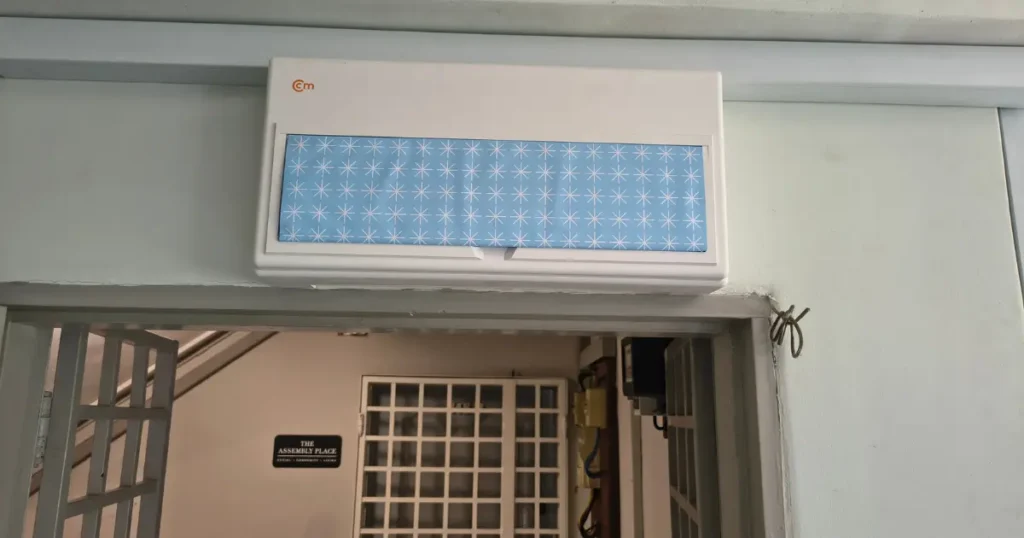
Why HDB Power Keeps Tripping in Singapore: A Homeowner’s Diagnostic Guide
If you live in an HDB flat and you’re resetting the main switch every few hours, that isn’t normal — and it isn’t something to keep living with. Our team traces this exact problem back to seven specific causes on almost every callout across Singapore’s HDB estates. Most are fixed in a single visit. A few are genuine fire risks, and if that’s what you’re dealing with, the right move is to stop resetting the switch and call a qualified electrician straight away.
This guide follows the same diagnostic process our electricians use on-site at MM Engineering Works, built around how HDB flats actually work — a 40A single-phase supply, the SS 638:2018 wiring code, and Singapore’s tropical humidity — rather than generic advice written for a cooler, drier climate.
TL;DR — the 30-second answer
Why does HDB power keep tripping in Singapore? Almost always, it comes down to one of three things:
- An overloaded circuit pulling more than the flat’s 40A supply can handle
- A faulty appliance leaking current to earth — most often a water heater or air conditioner
- Wiring that’s degraded after years of Singapore’s heat and humidity
The two clues that narrow it down fast are which device trips (the main switch, the RCCB, or a single MCB) and when it happens — at startup, under load, at random, or after rain.
🛑 Stop resetting and call a licensed electrician immediately if you smell burning plastic, see scorch marks, the main switch trips again the instant you reset it, or a socket feels hot to the touch.
Key takeaways
- A standard HDB flat is capped at a 40A single-phase main switch — everything running at once can’t exceed that
- Singapore’s heat and humidity speed up wiring insulation breakdown in ways temperate-climate advice doesn’t account for
- Only a Licensed Electrical Worker (LEW) registered with Singapore’s Energy Market Authority (EMA) may legally carry out this work
- Two trips of the same breaker inside 24 hours is the point to stop resetting and get it looked at
When to stop and call — not reset
Some tripping is safe to check yourself for thirty seconds. Some of it isn’t. Here’s the line.
🛑 Turn the main switch off and call an electrician if any of these are true:
- You smell burning plastic or anything chemical near the DB box, a socket, or a switch
- You see sparks, scorch marks, or discoloured plastic
- The main switch trips again the instant you reset it, repeatedly
- A socket or switch is hot to the touch
- The tripping started right after water got somewhere it shouldn’t — a leaking ceiling or a flooded bathroom
If you’re dealing with a power outage right now and it’s an emergency, our team covers every district in Singapore, including nights, weekends and public holidays.
✅ It’s fine to check things yourself first if:
- The breaker trips only when several high-draw appliances run at the same time
- It’s happened once, and you can point to what caused it
- Nothing feels hot, smells wrong, or looks damaged
How we actually diagnose HDB tripping
Most articles jump straight to a list of five reasons your breaker trips. That’s not how real diagnosis works — before anyone touches a tool, we ask three questions.
What’s tripping?
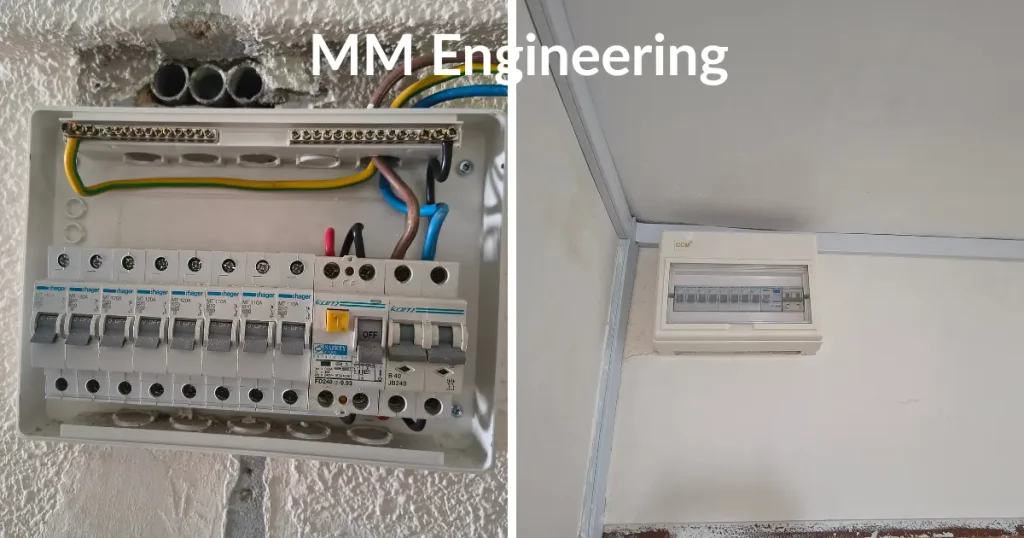
Open your DB box and look at what’s sitting in the OFF position.
- The main switch (the largest one, usually at the top) — the whole flat lost power. Points to an earth fault, a severe overload, or a problem further upstream.
- The RCCB (labelled with a “T” test button) — trips on earth leakage. Almost always a faulty appliance, degraded wiring, or moisture getting in.
- A single MCB (the smaller breakers labelled “lights,” “power,” “aircon,” “water heater”) — one circuit is overloaded or faulty. The label tells you where to look.
When does it happen?
Timing tells you almost as much as the breaker itself.
- At startup of one specific appliance → that appliance is very likely the cause
- Only once several appliances are running together → you’re hitting the 40A limit
- Randomly, no pattern → a loose connection, an intermittent earth fault, or a failing breaker
- During or after rain → moisture getting into an outdoor or balcony circuit, common in older blocks with cracked conduit
- At the same time every day → a timer-controlled appliance like a water heater or aircon scheduler
What changed recently?
Most HDB tripping problems start after a specific event. Think back over the last few months:
- Renovated recently? New circuits may have been added without redesigning the DB or upsizing the cabling.
- New appliance? An induction hob, dryer, or air fryer can overload a circuit that was never sized for it.
- Aircon serviced or replaced? A new compressor sometimes draws a higher startup current than the old one.
- Nothing’s changed? Then degradation is the likely culprit — ageing wiring insulation, an ageing RCCB, or an appliance nearing the end of its life.
With those three answers, here are the seven causes we actually see, ranked by how often they come up.
Why HDB Power Keeps Tripping in Singapore: The 7 Real Causes
1. An overloaded final circuit — the 40A limit most homeowners don’t know about
A standard HDB flat’s main switch caps out at 40A single-phase. That’s the absolute ceiling on what your whole flat can draw at any one moment, and modern households push it hard: a 9,000 BTU air conditioner pulls 4–6A, a water heater pulls up to 15A while heating, an induction hob can hit 32A at full power, and then there’s the washing machine, the fridge, the lights, and everything else that’s always on.
Run too many of those together and the main switch trips on overload. The fix isn’t to keep resetting it — the thermal cycling that causes shortens the switch’s working life. It’s either:
- Load management — don’t run the water heater and the induction hob at the same time
- A DB box upgrade with the load redistributed properly — only possible if SP Group’s supply allows it, and in some cases that means applying for a 60A supply upgrade
If you’ve renovated recently and added new appliances, this is almost always the cause.
2. A faulty aircon compressor or fan motor
Aircons cause more HDB tripping callouts than anything else. The pattern is easy to spot: tripping starts within minutes of the unit switching on, or gets worse the longer it runs.
A compressor or fan motor with failing insulation leaks current to earth once it warms up, and the RCCB — correctly — cuts the power. Aircon servicing companies sometimes miss this because their tools check refrigerant pressure, not electrical condition. The proper test uses an insulation resistance meter at the aircon isolator: a reading below 1 MΩ means the unit has electrical damage and needs repair or replacement.
3. Earth leakage from a water heater or kitchen appliance
An RCCB is built to trip at 30 mA of earth leakage — a deliberately tight threshold that protects against electric shock. A handful of everyday HDB appliances are the usual suspects for nuisance leakage:
- Storage water heaters — the heating element develops pinhole corrosion after 5–8 years in Singapore’s water, letting current leak to earth through the tank
- Built-in and steam ovens — the heating element’s insulation degrades from repeated thermal cycling
- Older fridges with worn compressor insulation
- Bathroom exhaust fans that have been pulling in humid air for years
The way to test it: unplug or switch off suspect appliances one at a time and see which one stops the tripping. If nothing you unplug makes a difference, the leak is likely in the fixed wiring itself, not an appliance.
4. Wiring degraded by Singapore’s heat and humidity
Wiring insulation is generally rated for 20–30 years, but that figure assumes a stable, dry environment. Singapore isn’t one. Sustained temperatures of 28–32°C, relative humidity of 75–95%, and wiring concealed in concrete slabs that trap heat all speed up insulation breakdown well ahead of schedule.
The visible symptoms:
- Tripping that started gradually and has been getting worse over months or years
- Tripping during or after heavy rain, as moisture wicks into degraded insulation at conduit joints
- Tripping concentrated on the original circuits rather than newer renovation ones
The test is an insulation resistance measurement between the live conductors and earth. SS 638:2018 — Singapore’s wiring code — sets a minimum of 1 MΩ for a healthy circuit. We routinely measure 0.2–0.5 MΩ in HDB flats over 25 years old, which means the wiring is electrically tired and any spike in humidity can set it off. For a flat with widespread low readings, the fix is partial or full rewiring of the affected circuits.
5. An oversensitive or failing RCCB
Sometimes the appliances are fine and the RCCB itself is the problem — age or a manufacturing fault can make it trip on leakage levels a healthy unit would ignore.
- No new appliances or wiring work, yet trips have increased
- Every “unplug and test” cycle fails to find the culprit
- A calibrated trip test shows it tripping around 10 mA instead of holding to 30 mA
The fix is a straightforward RCCB replacement, usually under an hour of work, and a good opportunity to upgrade to per-circuit RCBO protection while the DB is open.
6. An undersized DB box after a renovation
Renovation habits in Singapore have moved faster than most original HDB DB layouts ever anticipated. A DB designed in 2005 for three aircon points, one water heater, and halogen ceiling lights was never built for today’s typical renovation — four aircon zones, an induction hob, an instant water heater, a charging point for an electric vehicle, smart-home wiring, and LED downlights throughout.
When a renovation contractor adds circuits without redesigning the DB to match, you end up with a board working at or past its limit, and nuisance tripping becomes routine. The fix is a proper DB upgrade sized to the new load — not just swapping out whichever MCB keeps tripping.
7. A loose terminal at the MCB or main switch
The mundane cause that gets missed most often. Terminals loosen over time from:
- Thermal cycling — years of heating and cooling under load
- Under-torqued connections from the original installation
- Vibration from nearby aircon equipment or renovation work
A loose terminal builds up resistance, heats up locally, and trips the breaker — often with no particular pattern. The telltale sign is discolouration or browning around one specific terminal, sometimes visible through the DB’s front panel and easy to spot with a thermal camera during an inspection. This one is a genuine fire risk and worth acting on quickly: a proper fix means torque-testing every terminal in the board and replacing anything discoloured.
A quick way to match your symptom to the cause
If you only remember one table from this guide, make it this one.
| What’s tripping | When it happens | Most likely cause |
|---|---|---|
| Main switch | The moment several appliances run together | Overloaded circuit (40A limit) |
| RCCB | Aircon has been running a few minutes | Faulty aircon compressor |
| RCCB | Random, or after using the water heater or oven | Earth leakage from an appliance |
| RCCB | During or after rain | Moisture in outdoor wiring, or degraded insulation |
| RCCB | No pattern, no obvious appliance | Ageing RCCB or degraded wiring |
| Single MCB | Consistently on one circuit | Undersized DB or a loose terminal on that circuit |
When a DIY reset is fine — and when it really isn’t
| Situation | Safe to reset? | What to do |
|---|---|---|
| Trips once when several appliances run together | ✅ Yes | Spread the load next time |
| Trips again the instant you reset it | 🛑 No | Switch off, call an electrician |
| Trips only during heavy rain | ⚠️ Once | Book a diagnosis before the next downpour |
| Trips after recent renovation work | ⚠️ Once | Raise it with your contractor and get an independent opinion |
Rule of thumb: two trips of the same breaker inside 24 hours means stop resetting and call someone. Repeated thermal cycling wears out breakers and, if there’s an earth fault behind it, raises the risk of a live fire.
Preventing HDB power trips before they start
If you’re tired of asking why HDB power keeps tripping in Singapore every few months, here’s the good news: most of these causes build up slowly, which means they’re catchable before they turn into a 2am reset marathon. A simple annual check covers most of it:
- Test the RCCB’s “T” button once a year — it should trip instantly and reset cleanly
- Get insulation resistance checked if your flat is over 20 years old and hasn’t been rewired
- Have any new high-draw appliance — an induction hob, instant water heater, or EV charging point — checked against your DB’s actual capacity before installation, not after
- Ask your renovation contractor for a written load calculation whenever they’re adding circuits, not just a verbal “it’ll be fine”
- Keep an eye on any MCB or socket that feels warmer than the others — that’s usually the first sign of a loose terminal, well before it starts tripping
What it costs to fix HDB power tripping properly
Cost depends entirely on the cause. Indicative ranges from our 2026 Singapore electrician price guide:
- Diagnosis and single-circuit fix: S$120–S$280
- RCCB or MCB replacement: S$150–S$350 (parts and labour)
- DB box upgrade (full panel): S$500–S$1,400, depending on circuit count
- Partial rewiring (1–2 circuits): S$400–S$900
- Full rewiring: S$1,800–S$4,500, depending on flat size and access
These cover the time needed for diagnosis and any minor fixes done in the same visit. Bigger jobs — DB upgrades, partial rewiring, RCCB replacement — get quoted separately once we’ve actually seen the fault.
Choosing someone qualified to fix it
All regulated electrical work in a Singapore home has to be carried out or supervised by someone holding a Licensed Electrical Worker (LEW) certificate issued under the Energy Market Authority (EMA). Hiring someone without one is illegal, voids your home insurance for anything that goes wrong, and is a real safety risk — this isn’t a technicality worth skipping.
Before anyone touches your DB box, ask for two things: their personal licence card, showing their photo, licence number and class (Class 1, 2, or 3, depending on what work they’re allowed to do), and the company’s own contractor licence, since the business needs one as well as the individual doing the work. Both can be checked on the Energy Market Authority’s public licence search. A properly qualified electrician will hand this over without you having to ask twice — if someone stalls or gets defensive about it, that’s your answer.
MM Engineering Works Pte Ltd (UEN 202302469E) holds a current contractor licence, and every electrician on our team carries their own licence card, shown on arrival as standard.
Still not sure why HDB power keeps tripping in Singapore for your specific flat? We size up the actual fault before quoting, and we back every repair with a 90-day workmanship warranty. 👉 Request a site assessment, or WhatsApp +65 8145 3954 for a same-day response.
Frequently asked questions — HDB power tripping in Singapore
Why does my HDB main switch keep tripping, but the individual MCBs don’t?
That pattern usually points to either a whole-flat overload — several high-draw appliances exceeding the 40A supply together — or an earth fault picked up at the main level. Working out which one takes measuring current draw under load and testing earth leakage circuit by circuit, which a competent electrician can do in a single visit.
Is it safe to keep resetting the breaker in my HDB flat?
Resetting once after an obvious overload — too many appliances on at the same moment — is fine. Resetting the same breaker over and over isn’t: it means there’s an unresolved fault, and repeated thermal cycling wears the breaker down and raises fire risk if the underlying cause is an earth fault.
How much does it cost to fix HDB power tripping?
Most single-circuit diagnoses and fixes run S$120–S$280. Bigger repairs — RCCB replacement, a DB upgrade, or rewiring — cost more and get quoted after the electrician has actually seen the fault, since the price depends heavily on what’s wrong.
Can I fix my own HDB electrical fault if I know what I’m doing?
No. Under Singapore’s Electricity Act, any regulated electrical work — anything touching the DB box, fixed wiring, or the installation itself — must be done or supervised by a Licensed Electrical Worker. Swapping a plug-in appliance is fine; opening the DB box isn’t, and doing so anyway is illegal, voids your home insurance, and carries real shock and fire risk.
Why does my HDB power only trip when it rains?
Rain-linked tripping almost always means moisture is getting into a damaged outdoor or balcony circuit — usually through a cracked external conduit joint or a degraded ceiling light fitting. The fix is finding exactly where the water’s getting in and replacing that section of wiring. Don’t leave this one — wet wiring is both a shock and a fire risk.
My power started tripping after a renovation. Is that my contractor’s fault?
Possibly. If new circuits were added without redesigning the DB for the extra load, that’s a design oversight, not bad luck. Get an independent electrician — separate from your renovation contractor — to run a DB load assessment and give you a second opinion.
How long does an HDB DB box upgrade take?
Typically 2–4 hours of on-site work in a single day, with the flat’s power off for most of that window. We schedule around you and aim to have power back on well before evening.
Do you offer a warranty on electrical troubleshooting work?
Yes — a 90-day workmanship warranty on all troubleshooting and installation work. If the same fault comes back within 90 days because of our workmanship, we return and fix it at no extra charge.