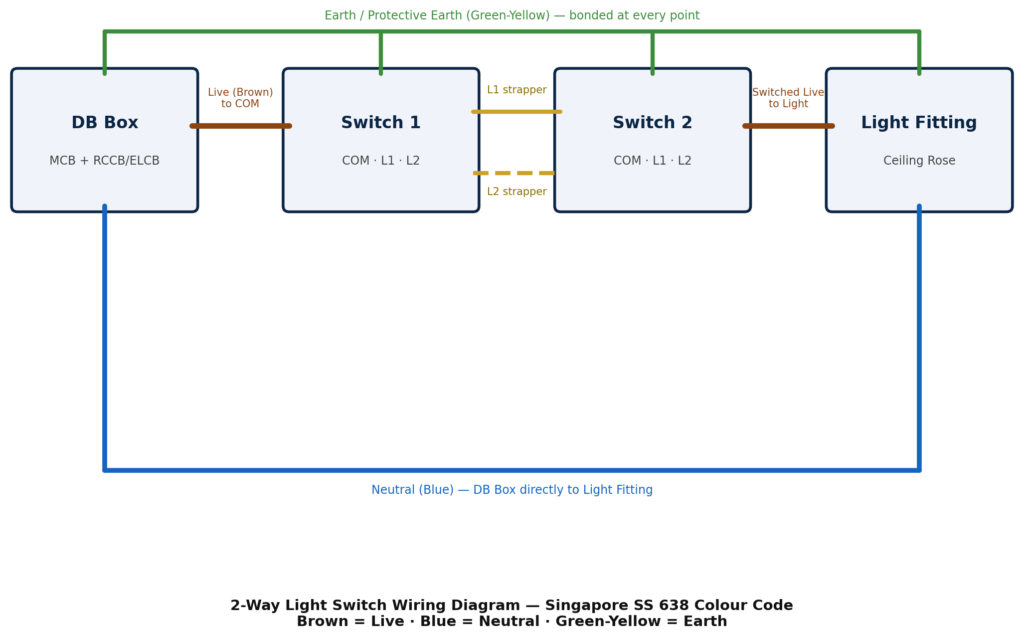
Quick answer: A 2-way light switch wiring diagram uses two 2-way switches, each with COM, L1 and L2 terminals. The incoming brown live wire connects to COM on Switch 1; a pair of strapper wires link L1-to-L1 and L2-to-L2 between Switch 1 and Switch 2; COM on Switch 2 feeds the light fitting. Neutral (blue) runs directly from the DB box to the light, and earth (green-yellow) is bonded at every point. This lets the light be switched ON or OFF from either location — e.g. top and bottom of a staircase.
If you own an HDB flat, condo, or landed property in Singapore, you’ve almost certainly used a 2-way light switch without realising it. A 2-way light switch wiring diagram is simply the wiring setup that lets you flick a light ON at the bottom of your staircase and OFF at the top — or control a hallway or master bedroom light from two separate switch points.
Before touching any wiring diagram, you need to know what each terminal and wire colour means under Singapore’s SS 638 wiring standard.
A standard (1-way) switch simply breaks or completes the live connection to a light from a single location — it has only two terminals (COM and L1).
A 2-way switching system uses two 2-way switches (each with COM, L1, and L2 terminals) connected by a pair of strapper wires, allowing the light to be controlled from either location. If a third control point is needed, an intermediate switch is added between the two 2-way switches — known as “2-way and intermediate switching.”
This usually indicates an earth fault — often a live wire touching the earth conductor or metal switch plate, or moisture ingress in older HDB wiring. Do not keep resetting the breaker; this is a sign of a genuine fault worth having checked.
If the light only works in specific combinations instead of toggling from either switch, the L1/L2 strappers have been crossed or the COM terminal has been wired as a strapper by mistake. This is the most common DIY wiring error and requires re-checking every terminal against the schematic.
Many older HDB flats still use mechanical toggle or rocker switches. Upgrading to smart switches usually requires a neutral wire at the switch point (many older installations don’t have one) and compatible strapper wiring — this often means partial rewiring, which is worth having assessed on site if you’re unsure.
Understanding a 2-way light switch wiring diagram is not the same as carrying out the work yourself. Here’s how a DIY attempt compares to professional installation:
| Factor | DIY Attempt | Professional Installation |
|---|---|---|
| SS 638 / EMA Compliance | May not meet SS 638 wiring standards if unfamiliar with the code | Carried out in line with SS 638 and EMA guidance |
| Safety Risk | Higher risk of shock, fire, or incorrect earth bonding | Tested, certified, and insured work |
| Insurance/Warranty | May affect home insurance or fitting warranties | Insurance and warranty considerations addressed |
| Fault Diagnosis | Limited to visual inspection and guesswork | Proper testing instruments and troubleshooting expertise |
| Time & Long-Term Cost | Risk of repeat call-outs or re-work | Done right the first time, with after-service support |
If your job requires certified work, our team at MM Engineering Works is an EMA licensed electrician Singapore homeowners trust for switch installations, rewiring, and DB box upgrades — we can send a Licensed Electrical Worker (LEW) to your site if required, across HDB, condo, and landed properties.
It’s the wiring layout for controlling one light from two switch locations, using two 2-way switches connected by strapper wires (L1 and L2) between their COM terminals.
COM is the common terminal that carries the live feed in or out. L1 and L2 are the strapper terminals that connect Switch 1 to Switch 2, letting either switch control the light.
Singapore follows the SS 638 colour code: brown for live, blue for neutral, and green-yellow for earth.
You can learn how the circuit works from a diagram, but for the actual wiring, engaging a Licensed Electrical Worker (LEW) is recommended if the job requires certified work.
This usually means the L1/L2 strapper wires are crossed, or a COM terminal was wired as a strapper by mistake — each terminal needs re-checking against the diagram.
Whether it’s a tripping RCCB, a faulty 2-way switch, a DB box upgrade, or a full rewiring job, MM Engineering Works is a 1st Class EMA-licensed electrical contractor with 10 years of experience across Singapore. We’ll send a Licensed Electrical Worker (LEW) to your site if the job requires one.
