Your aircon kicks in, the water heater switches on, and the breaker trips. If that scenario sounds familiar, the culprit often comes down to whether your property runs on single phase or three phase power.
Both are forms of alternating current (AC), which behaves like a wave rising and falling in a steady rhythm. The real difference between single phase and three phase lies in how many of these waves reach your property at once, and that determines how much electrical load your wiring can comfortably carry.
This guide breaks down single phase vs three phase power in plain English. You’ll learn how each system works, how to check which one you currently have, and when it’s worth upgrading.
Short answer: single phase power uses one live wire and delivers around 230V, which is enough for most homes and everyday appliances. Three phase power uses three live wires working together to supply a constant 400V, built for heavy equipment, large air-con systems, and commercial or industrial loads.
Here’s the 1 phase and 3 phase difference at a glance:
| Feature | Single Phase (1-Phase) | Three Phase (3-Phase) |
|---|---|---|
| Voltage | ~230V | ~400V |
| Wiring | 2 wires (1 live + 1 neutral) | 4 wires (3 live + 1 neutral) |
| Best for | Flats, small apartments, light household use | Landed homes with heavy loads, offices, factories |
| Power delivery | Pulsing, with small fluctuations | Continuous and steady |
| Efficiency | Fine for low-to-medium loads | Better suited to heavy equipment |
Single phase power delivers electricity through one alternating current wave, carried on a live wire plus a neutral wire to complete the circuit. It’s the standard setup for most Singapore homes, including HDB flats and smaller shops.
Typical voltage: around 230V.
Common uses: lighting, fans, televisions, laptops, and standard refrigerators.
Three phase power combines three separate AC waves, each offset from the others, so as one wave dips another is rising. The result is a continuous, near-constant flow of energy rather than the gentle pulsing you get with single phase.
Typical voltage: around 400V.
Common uses: commercial buildings, factories, large landed properties, and homes fitted with fast EV chargers or multiple heavy-duty air-con units.
Weighing up single phase vs three phase power for your own property comes down to three practical factors: smoothness of supply, wiring, and cost.
Single phase electricity pulses, briefly dropping toward zero many times a second before rising again. Three phase avoids this dip because its three overlapping waves keep at least one phase supplying power at all times, so equipment runs smoother.
Picture single phase as a single-cylinder engine, delivering power in distinct pulses. Three phase behaves more like a V6, spreading the work across three cylinders for a steadier output.
Single phase pushes all the current through one live wire. Three phase spreads that same load across three conductors, so no single wire is doing all the heavy lifting.
This is why heavy machinery, lifts, and large air-con compressors are usually wired for three phase. Spreading the load reduces wear on the cabling and lowers the chance of nuisance tripping, the kind our troubleshooting team gets called out for often.
A common misconception is that three phase electricity costs more per kilowatt-hour. It doesn’t, since electricity retailers bill residential and commercial customers on the same energy tariff regardless of phase type.
What changes is efficiency. Motors and compressors running on three phase waste less energy as heat, so heavy equipment can cost less to run over time, even though the initial installation is pricier.
Once you understand single phase vs three phase power in theory, the next step is confirming which one is actually installed at your property.
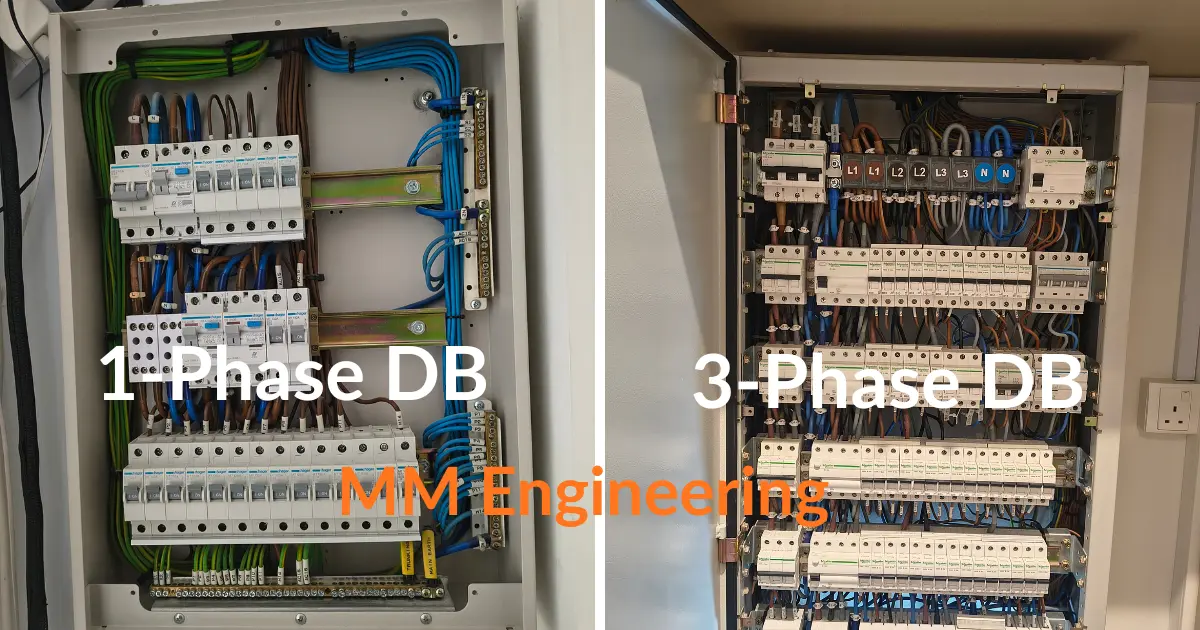
Open your DB box and look at the main breaker. A single phase setup typically has a single-pole or double-pole main switch, and it looks fairly narrow.
A three phase setup has a triple-pole or four-pole main breaker instead. It’s noticeably wider, usually with three or four linked toggles that move together.
Your meter usually states the phase type directly, printed as “1-Phase 230V” or “3-Phase 400V”. If the label has worn off or you’re still unsure, a licensed electrician can confirm it within minutes.
Deciding on single phase vs three phase power isn’t purely theoretical. Certain real-world changes make an upgrade worth considering:
If more than one of these applies to you, it’s worth arranging a load assessment before committing to new equipment.
Upgrading from single phase to three phase isn’t a DIY job. It needs to go through a Licensed Electrical Worker (LEW), who assesses your current load and wiring before submitting the application to SP Group, Singapore’s power grid operator.
The general process looks like this:
Costs vary depending on your property type and how much rewiring is needed. Budget for the DB box upgrade, internal wiring changes, and grid connection charges, on top of the LEW’s assessment and installation fees.
Neither is strictly better; they’re suited to different loads. Single phase is perfectly adequate for typical homes, while three phase is built for heavy equipment and commercial demand. Weighing single phase vs three phase power really comes down to your expected load.
No. Any upgrade must be carried out by a Licensed Electrical Worker and approved by SP Group, since it involves your property’s grid connection.
Not inherently. You’re billed for the energy you consume in kWh, not the phase type. Three phase simply lets heavy equipment run more efficiently.
Fast EV chargers rated above roughly 7.4kW, including most 22kW Level 2 chargers, typically require a three phase supply. Your installer or an LEW can confirm the exact requirement for your charger model.
Single phase power comfortably handles everyday household living: lighting, fans, laptops, and a standard fridge. Three phase power is the backbone for heavier demands, from fast EV charging to industrial machinery.
If you’re planning to install a fast charger, add heavy-duty air-con, or bring in commercial equipment, get a proper load assessment first. Our licensed electricians can check your current setup and advise whether an upgrade makes sense before you spend on new equipment. Get in touch to arrange a single phase vs three phase power assessment for your property.
