A commercial electrical contractor Singapore businesses rely on is only as good as the hour the power goes out. When a main breaker trips at 2pm on a weekday, nobody cares about a glossy company profile. You care about three things: how fast a Licensed Electrical Worker (LEW) is on site, whether they find the real fault instead of resetting the breaker and leaving, and whether the fix will survive an EMA inspection.
This guide is written for facility managers, business owners, and main contractors who manage offices, retail units, F&B outlets, warehouses, and light-industrial premises. It explains what EMA and BCA actually require, how to vet a contractor in under 15 minutes, and the exact process MM Engineering Works uses to keep commercial sites powered, compliant, and audit-ready.
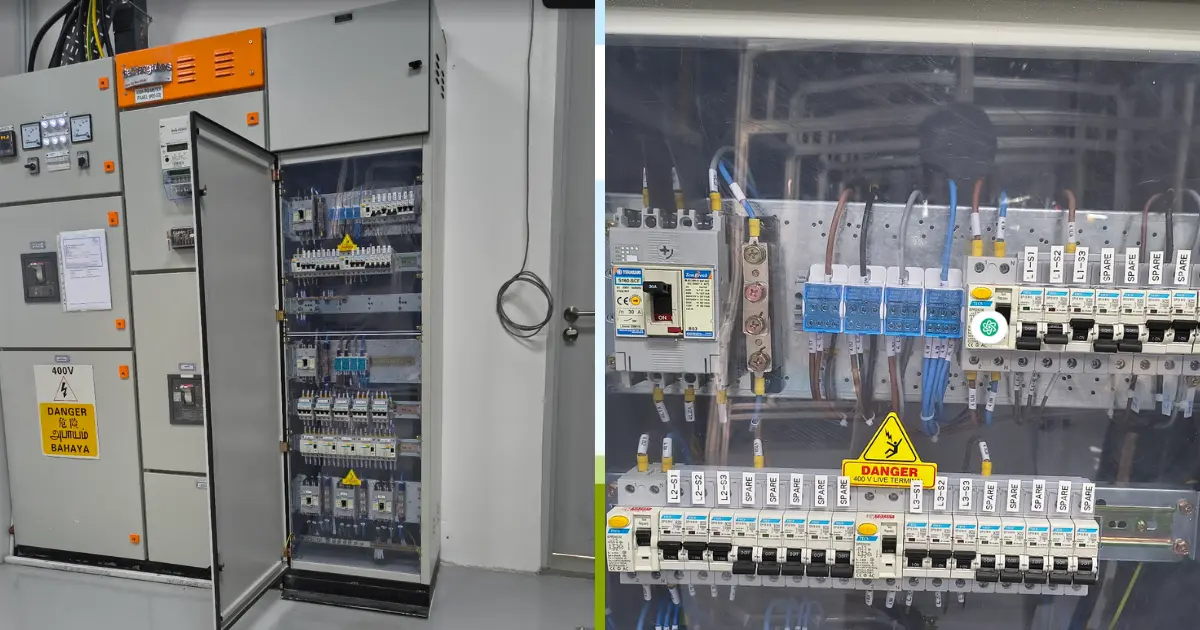
What does a commercial electrical contractor in Singapore do? A commercial electrical contractor designs, installs, tests, and maintains electrical systems in non-residential premises — including 3-phase switchboards, distribution boards, sub-mains, lighting, power points, and fire alarm interfaces. Work must comply with the Electricity Act, SS 638 (Code of Practice for Electrical Installations), and EMA licensing rules, and must be carried out or supervised by an EMA-licensed LEW whose licence class covers the installation’s approved load.
In a 1,000 sq ft HDB flat, a power trip is an inconvenience. In a commercial unit, it is a chain reaction:
Then there is the cost nobody budgets for: non-compliance. An undocumented alteration to a licensed installation, an expired electrical installation licence, or a fire alarm interface that was never properly tested can surface during an EMA check, an SCDF inspection, a landlord handover, or an insurance claim — usually at the worst possible moment.
Most repeat power trips we are called to have already been “fixed” at least once. The pattern is predictable:
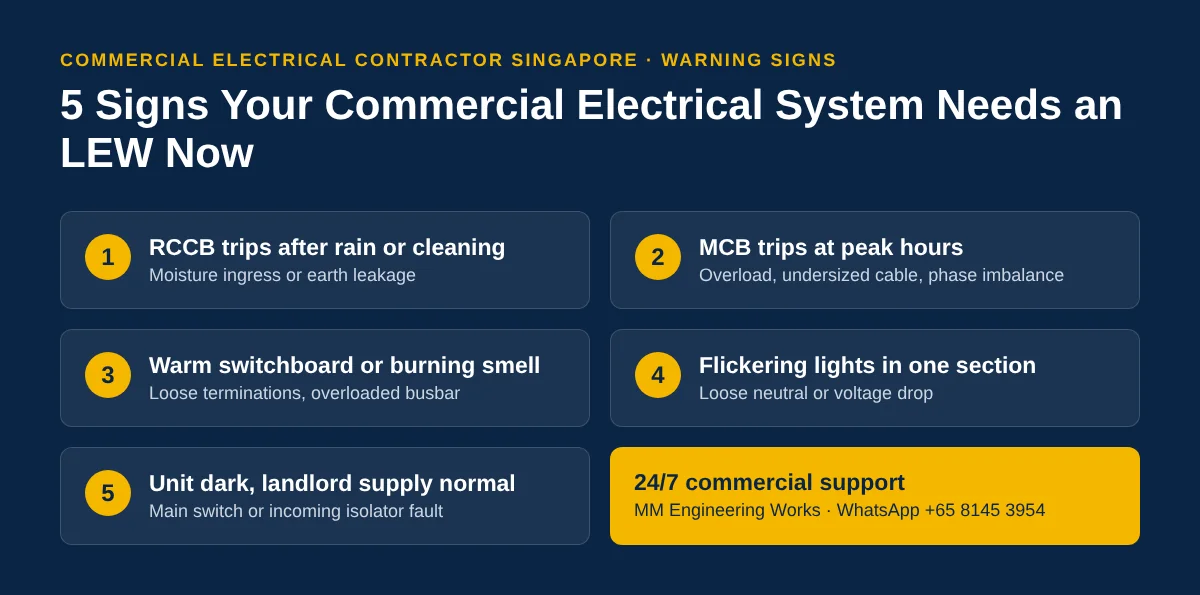
| Symptom you see | What it often indicates | Risk if ignored |
|---|---|---|
| RCCB trips when it rains or after cleaning | Moisture ingress, damaged outdoor/kitchen circuits, earth leakage | Shock hazard, recurring outages |
| MCB trips at peak hours | Circuit overload, undersized cable, unbalanced phases | Overheating cables, fire risk |
| Warm or discoloured switchboard cover, burning smell | Loose terminations, overloaded busbar, failing breaker | Arcing, switchboard fire, prolonged shutdown |
| Flickering lights across one section | Loose neutral, failing contactor, voltage drop | Equipment damage, staff complaints |
| Whole unit loses power, landlord supply is normal | Main switch / incoming isolator fault inside your installation | Full business stoppage |
Commercial electrical work in Singapore sits under several regulators at once. A top-tier commercial electrical contractor Singapore clients can trust works fluently across all of them. Here is what each one governs and what you should verify.
How to choose a reliable commercial electrical contractor in Singapore
The Energy Market Authority (EMA) regulates electrical installations and electrical workers under the Electricity Act. For most commercial tenants and building owners, the key obligations are:
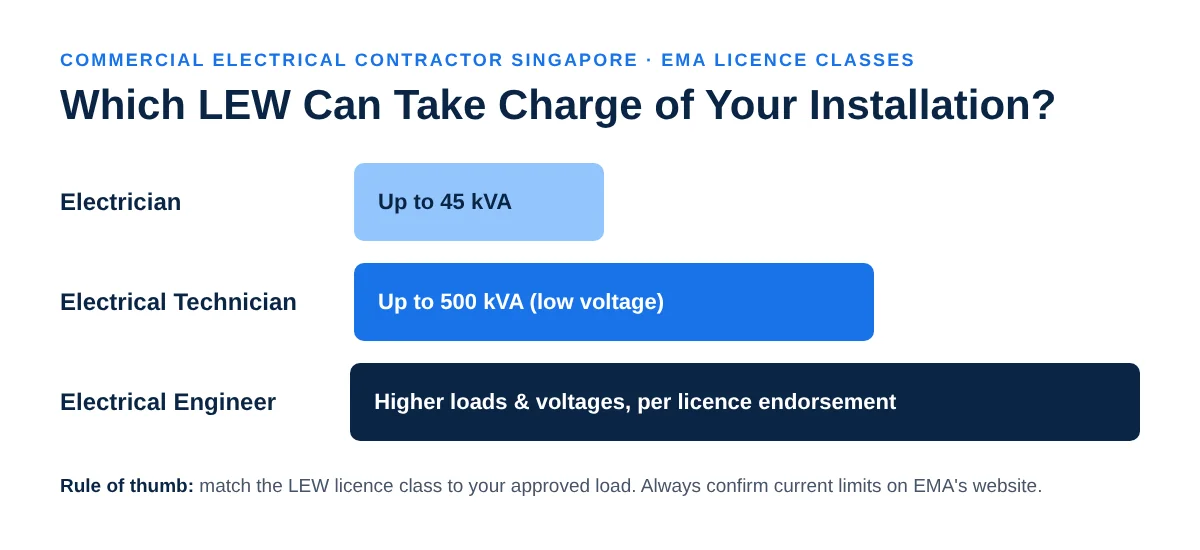
| LEW licence class | Typical scope (low-voltage installations) | Common commercial fit |
|---|---|---|
| Electrician | Approved load up to 45 kVA | Small shops, single-unit offices, kiosks |
| Electrical Technician | Approved load up to 500 kVA | Restaurants, multi-unit offices, clinics, small factories |
| Electrical Engineer | Higher loads and voltages, per licence endorsement | Large commercial buildings, industrial plants, HV intakes |
Always confirm current thresholds and licence scope on EMA’s website — rules are updated periodically.
The Building and Construction Authority (BCA) runs the Contractors Registry System. Electrical contractors are registered under workhead ME05 (Electrical Engineering), graded by financial and track-record criteria. Public-sector tenders require it; many private main contractors and property managers use it as a pre-qualification filter. If you are a main contractor appointing an electrical subcontractor, BCA-registered status is a quick proxy for financial stability and documented track record.
Commercial fit-outs routinely touch fire safety systems: shutting down AHUs on alarm, releasing magnetic door locks, interfacing with the building’s fire alarm panel. These interfaces fall under the SCDF Fire Code and SS 645 (electrical fire alarm systems). A competent contractor coordinates with the building’s fire alarm vendor and Qualified Person, tests every interface, and documents it — so your Fire Safety Certificate process isn’t held up by a missing relay test.
MM Engineering Works is an EMA-licensed commercial electrical contractor Singapore facility managers call for both planned and emergency work, with 10 years of field experience across offices, retail, F&B, warehouses, and government-linked sites — including project work for ICA at Jurong Port. Every commercial engagement is structured around four core service lines, backed by preventive maintenance.
Your switchboard is the single point of failure for the entire premises. We design, supply, and install 3-phase (400V) main switchboards and distribution boards sized for your actual load — not the load you had five years ago.
Related: DB box upgrade · single phase vs three phase power
Many businesses discover they need an LEW only when a landlord, insurer, or authority asks for paperwork. We handle the full compliance chain:
When the power goes, our priority is to make your premises safe first, operational second, and permanently fixed third — without skipping the diagnosis.
Related: emergency electrician Singapore · power trip repair · electrical troubleshooting
Lighting is one of the easiest commercial energy costs to cut — and one of the most visible to customers and staff. We start with an energy efficiency audit, not a product catalogue.
Related: lighting installation Singapore
The cheapest power trip is the one that never happens. Our preventive maintenance contracts turn electrical upkeep into a predictable line item:
| Premises type | Typical electrical priorities |
|---|---|
| Corporate offices & co-working spaces | Clean power for servers and network racks, dedicated circuits for pantry appliances, access control and lighting zones, after-hours fit-out works |
| Retail shops & shopping mall units | Display and track lighting, POS and signage circuits, landlord-compliant DB layouts, reinstatement works at lease end |
| F&B outlets & central kitchens | 3-phase supply for cookers, ovens and chillers, earth leakage protection in wet areas, exhaust and fire alarm interfaces |
| Warehouses & light-industrial units | Motor and compressor loads, high-bay LED lighting, phase balancing, isolators for machinery maintenance |
| Clinics, labs & education centres | Protected circuits for medical and lab equipment, emergency lighting, temperature-controlled storage on dedicated supply |
Whatever the premises, the principle is the same: size the installation for how the space is actually used today, document every change, and keep one LEW accountable for the whole system.
Facility managers tell us the hardest part of hiring an electrical contractor isn’t the work — it’s the uncertainty. Unclear scope, surprise variations, and paperwork that shows up weeks late. Our process removes that uncertainty in three steps.
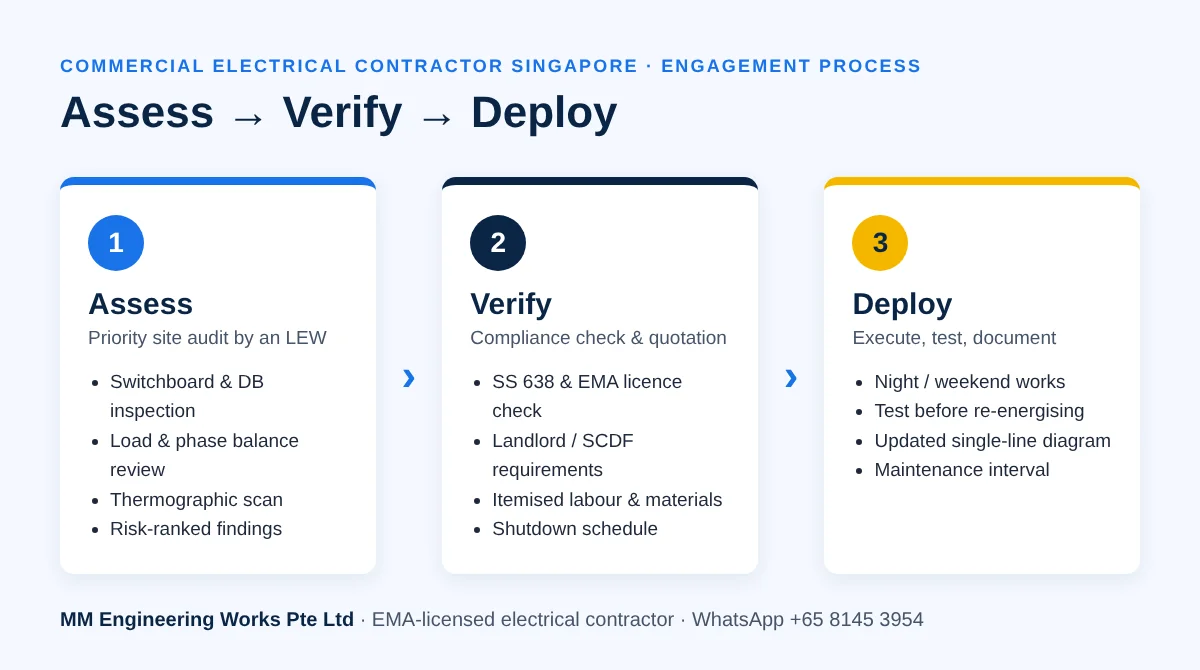
An LEW visits your premises, at a time that suits your operations, and inspects the switchboard, distribution boards, high-load circuits, lighting, and any fire alarm interfaces. Where needed, we carry out insulation resistance testing and thermographic scanning.
You receive: a findings summary ranked by risk (urgent, plan within 3 months, monitor), with photos.
We map each finding against SS 638, your installation licence status, and any landlord or SCDF requirements. Then we price the work line by line — labour, materials, and testing — so you can approve all of it, or only the urgent items.
You receive: an itemised quotation, a proposed shutdown schedule, and a list of any authority submissions required.
Work is carried out during agreed windows — nights, weekends, or planned shutdowns. Every circuit we touch is tested before re-energisation.
You receive: test results, updated single-line diagram and circuit schedule, completion photos, and a recommended maintenance interval.
How long does a commercial switchboard upgrade take in Singapore? For a typical small-to-mid commercial unit, the physical changeover is usually planned into a single shutdown window — often overnight or over a weekend — once materials are on site. Lead time depends mainly on switchgear availability and whether an EMA or SP Group submission is needed for a load increase.
You don’t need to commit to a project to find out where your risks are. Start with a site audit — and decide what to fix, and when, based on facts.
Best for: offices, retail and F&B outlets, clinics, warehouses, and main contractors needing a reliable electrical subcontractor.
WhatsApp +65 8145 3954 Call for Emergency Support Email contact@mmengine.comDo I need an LEW for electrical work in my commercial unit?
Yes. In Singapore, electrical installation work must be carried out by or under the supervision of an EMA-licensed Electrical Worker. Licensed commercial installations also need a named LEW in charge.
How do I verify a commercial electrical contractor Singapore company is properly licensed?
Search the LEW’s name or licence number on EMA’s public register, confirm the licence class matches your approved load, and — for building projects — check BCA registration under workhead ME05.
Can you work outside business hours?
Yes. Most commercial shutdowns, switchboard changeovers, and retrofits are scheduled at night or on weekends to keep your operations running.
Do you take on subcontract work for main contractors?
Yes. We work as the electrical subcontractor on fit-out and renovation projects, including LEW endorsement, testing, and handover documentation.
What’s the difference between a commercial and a residential electrical contractor?
Commercial work typically involves 3-phase supply, higher approved loads, installation licensing, fire alarm interfaces, and strict shutdown coordination — areas where residential-focused contractors may lack the licence class or experience. For our full range of services, see our electrical contractor Singapore page.
MM Engineering Works Pte Ltd · 5 Lorong 4 Geylang, Singapore · +65 8145 3954 · contact@mmengine.com
