Need a grease trap in Singapore installed, cleaned or repaired? Our PUB licensed plumber team supplies, installs and services grease traps for restaurants, cafés, food stalls and central kitchens, and clears the kitchen drains connected to them.
Quick answer: A grease trap in Singapore is a tank fitted to a kitchen drain that holds back fats, oils and grease before wastewater reaches the public sewer. Food outlets that discharge kitchen wastewater are generally required to have one and to keep it maintained, so check your tenancy terms and the relevant authority’s rules. A trap that is not emptied often enough will smell, overflow and block the kitchen drain. MM Engineering Works supplies, installs, cleans and repairs grease traps, and confirms the price before starting.
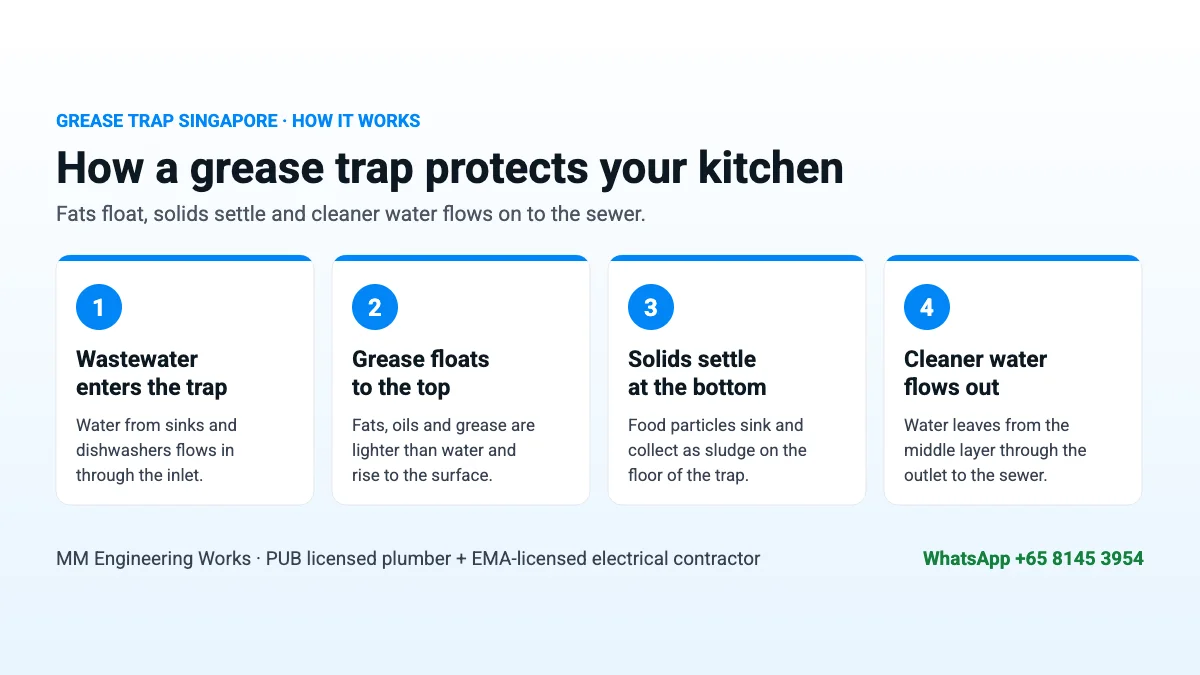
A grease trap uses simple physics. Hot, greasy water slows down inside the tank and cools. Fats, oils and grease float to the top, food solids sink to the bottom, and the cleaner water in the middle flows on to the sewer.
Wastewater from sinks, wash areas and dishwashers enters through an inlet pipe and baffle that slows the flow.
As the water cools, grease rises and forms a layer on top while food particles settle as sludge.
Water leaves from below the grease layer, so most of the grease stays in the trap.
The grease layer and sludge must be pumped or scooped out regularly, or the trap stops working.
We handle the full life of a grease trap, from choosing the right size to keeping it working.
We recommend a size and type for your kitchen, then install and connect it to your sinks and drain line.
Grease and sludge removed, baffles and inlet/outlet cleared, and the trap checked for damage.
Cracked covers, leaking joints, broken baffles and corroded parts repaired or replaced.
Old, undersized or damaged traps replaced with minimal disruption to your kitchen.
Blocked drains between the sinks and the trap cleared. See drain cleaning and hydro jetting.
Regular visits planned around your opening hours so the trap never reaches overflow.
Food outlets that discharge kitchen wastewater are generally required to have a grease trap and to keep it properly maintained. The exact requirement depends on the type of premises, so check your tenancy agreement and the guidance from PUB before you fit out.
We are not a regulator. If you are unsure, ask your landlord or management office what they require, then we can size and install a grease trap to suit.
A grease trap that is overdue for cleaning gives clear warnings. Acting early avoids an overflow during service.
There is no single schedule for every kitchen. It depends on the size of the trap and how much grease your cooking produces.
| Kitchen type | Typical cleaning frequency | Why |
|---|---|---|
| Busy restaurant or zi char | Weekly to fortnightly | High volume of oily cooking and washing |
| Café or bakery | Fortnightly to monthly | Moderate grease from baking and dishwashing |
| Food court or hawker stall | Weekly to monthly | Small traps fill quickly in peak periods |
| Central or cloud kitchen | Weekly or as advised | Long cooking hours and large volumes |
| Light-use pantry | Every few months | Little grease, but sludge still builds up |
These are typical ranges only. We recommend a schedule after inspecting your trap and kitchen.
An undersized grease trap fills fast and smells; an oversized one costs more and takes space you may not have. Size depends on several factors.
Each sink and wash point connected to the trap adds to the flow it must handle.
How much water the sinks and dishwashers discharge at peak times.
Deep frying, wok cooking and meat preparation produce far more grease than drinks or reheating.
Under-sink, floor-mounted and in-ground traps suit different kitchen layouts.
The trap must be easy to open and empty, or it will not be serviced often enough.
Some malls and buildings set minimum sizes or approved trap types.
A new grease trap is usually installed during fit-out or a short closure so it does not disrupt service.
We check the kitchen layout, sinks, drain line and where the trap can fit with good access.
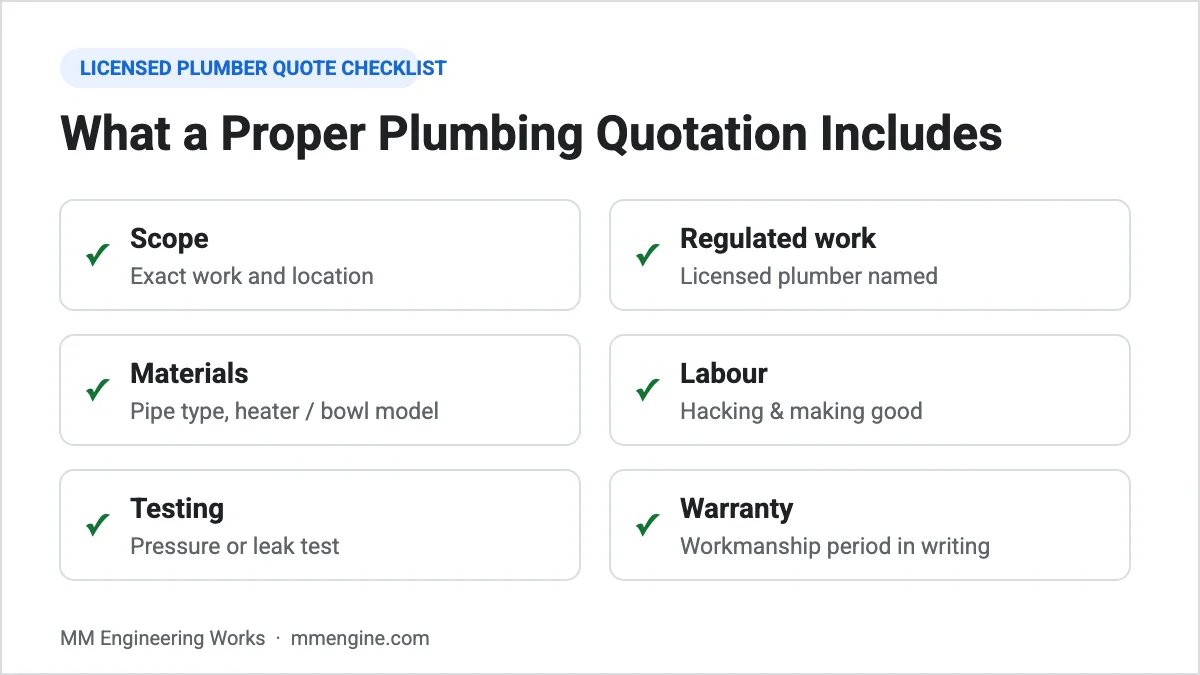
We recommend a trap type and size and give you a written quotation.
The trap is positioned, connected to the sinks and drain line, sealed and levelled.
We run water through the system, check for leaks and show your staff how the trap works.
Grease trap jobs vary widely, so we quote after seeing the kitchen. These are the factors that change the price.
| Job | What changes the price |
|---|---|
| Supply and installation | Trap size and material, number of connections, floor works needed |
| One-off cleaning | Size of trap, how long since last cleaned, amount of hardened grease |
| Scheduled servicing | Frequency of visits, number of traps, working hours |
| Repair | Parts needed, condition of the trap, access |
| Replacement | Removal of the old trap, changes to pipework, new trap size |
Send us photos of your trap and kitchen sinks on WhatsApp for a faster quotation.
Most grease trap problems come from habits in the kitchen, not from the trap itself.
We work with food businesses of all sizes across Singapore.
Under-sink and floor traps installed, cleaned and repaired, with visits planned outside service hours.
Larger traps and long drain runs serviced on a schedule, with clearing of connected lines.
Work coordinated with management, including permits and access times.
Small domestic traps for landed homes and large family kitchens, on request.
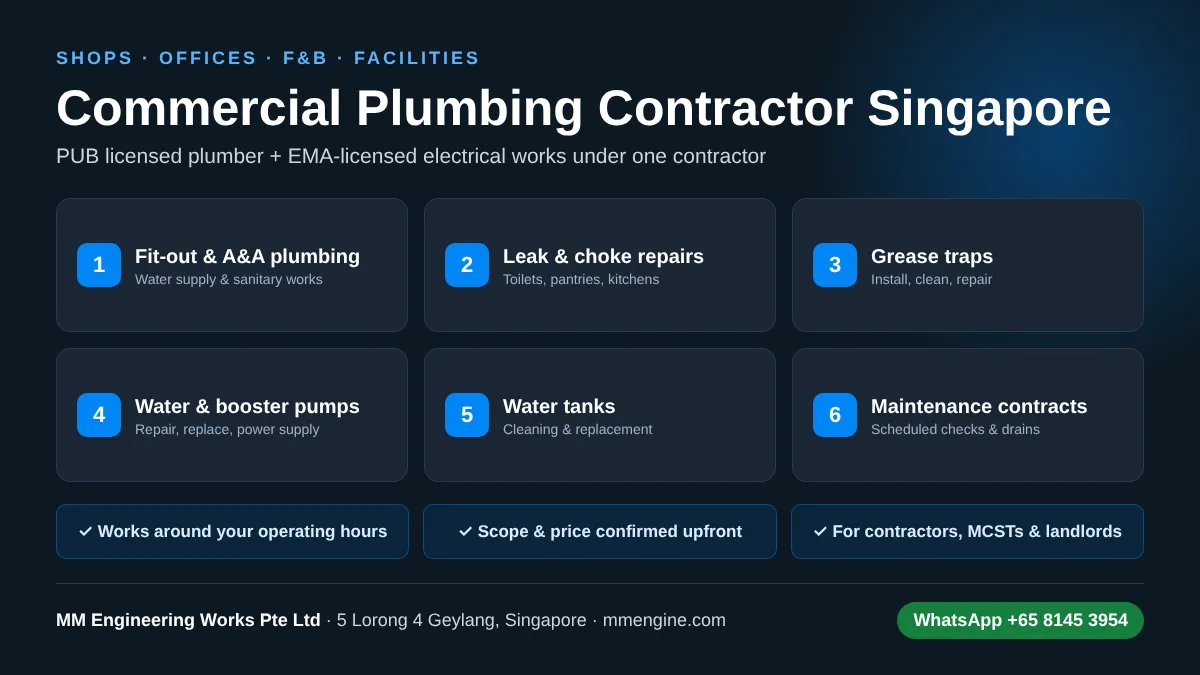
MM Engineering Works is a 1st Class EMA-licensed electrical contractor with a PUB licensed plumber, so one team can handle the trap, the drains and any kitchen electrical points around them.
Useful when a trap or sink move also needs new power points for dishwashers or water heaters.
Scope and price confirmed before work begins.
Work scheduled around your opening hours wherever possible.
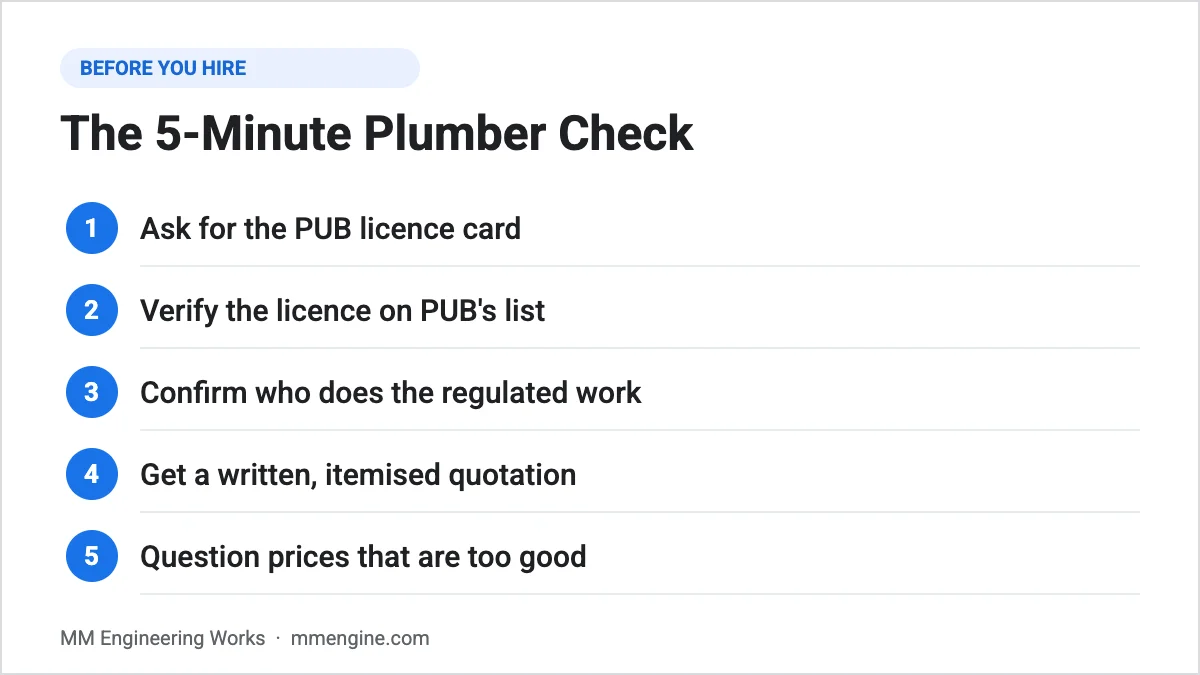
Train every shift on these habits and the trap will need less emergency attention.
The right type depends on your kitchen layout, the amount of grease and how easily the unit can be opened for cleaning.
| Type | Where it goes | Best for |
|---|---|---|
| Under-sink trap | Directly below one or two sinks | Small cafés, stalls and kitchens with limited floor space |
| Floor-mounted trap | On the kitchen floor near the sinks | Restaurants with several sinks and a dishwasher |
| In-ground trap | Set into the floor with a removable cover | Larger kitchens where floor space must stay clear |
| Central trap | Shared by several units, usually by the building | Food courts and malls where the landlord provides one |
| Stainless steel unit | Under-sink or floor | Kitchens that want a durable, easy-to-clean finish |
A standard cleaning visit is planned to keep your kitchen running and leave the area clean and dry.
Floor sheets go down and nearby food and equipment are kept clear of the work.
The grease layer is scooped or pumped out, then the settled sludge is removed from the bottom.
Baffles, inlet and outlet are scraped and flushed so water can flow freely again.
We check seals, cover and pipes for damage, refit the cover and tell you what we found.
These details help us quote accurately and bring the right equipment the first time.
Pin this near the sinks so every shift knows what to do.
Food outlets that discharge kitchen wastewater are generally required to have a grease trap and keep it properly maintained. Check with your landlord or the relevant authority for the requirements that apply to your premises.
It depends on the size of the trap and how much cooking your kitchen does. Busy kitchens often need cleaning weekly or fortnightly. We recommend a schedule after checking your trap.
Smells usually mean grease and food waste are decomposing inside a trap that is due for cleaning, or that the trap or its seals are damaged.
It fills up, smells, overflows and lets grease into the drain, which can block the kitchen drain and the pipes beyond it.
Yes, if the kitchen layout and flow allow it. Larger kitchens may need a floor-mounted or in-ground trap instead.
It depends on the trap size and type, the pipework needed and access. We quote after a site survey or after seeing photos of the kitchen.
No. Additives may break grease into smaller particles that pass into the drain and harden further down. The trap still needs to be emptied.
Yes. We clear blocked kitchen drains and lines connected to the grease trap, and can use hydro jetting for heavy grease build-up.
We work Monday to Saturday, 9am to 6pm, and plan visits around quieter periods in your kitchen wherever possible.
Yes. MM Engineering Works has a PUB licensed plumber and is also a 1st Class EMA-licensed electrical contractor.
Clogged and greasy drains cleared.
Learn more →Plumbing for shops, offices and F&B.
Learn more →Toilet, sink and floor trap chokes cleared.
Learn more →See all plumbing services in Singapore.
WhatsApp us a photo of your trap and kitchen sinks with your postal code. We will confirm the earliest slot and the price.
MM Engineering Works Pte Ltd · 5 Lorong 4 Geylang, #04-01, Singapore 399264 · contact@mmengine.com · Mon–Sat 9am–6pm
