
Last updated: 2 November 2026 · Written by: Malek Bin Sohrab, Project Coordinator, MM Engineering Works Pte Ltd (EMA-licensed electrical contractor, 10+ years in Singapore homes and commercial sites)
Sparking socket: the quick answer
A sparking socket (one that sparks, buzzes, feels hot or smells burnt) usually has a loose or overheating connection behind the faceplate, worn socket contacts, or too much load plugged in. Switch the socket off, turn off that circuit’s breaker at your DB box if it’s safe to do so, unplug everything, and stop using the socket until a Licensed Electrical Worker (LEW) has checked it. One tiny blue spark when you plug in a high-power appliance with the socket switched on can be normal. A large spark, repeated sparks, black or brown scorch marks, melting, crackling or a fishy or burning-plastic smell is not normal.
Key takeaways
- Brief, small spark on plug-in = usually normal. Large, repeated or orange/yellow sparks = fault.
- Burning smell or scorch marks = stop using it now. Heat damage is already happening inside the socket.
- Your RCCB may not trip. A loose connection can overheat at normal current, so neither the RCCB nor the MCB sees a fault.
- Electrical-origin fires are common in Singapore homes. SCDF recorded 304 electrical-origin fires in residential premises in 2025, out of 1,051 residential fires.
- Typical fix: replacing a burnt 13A socket usually costs S$80–S$150. Repairing a damaged cable or circuit costs more (see the cost table below).
In this guide
What to do when a power socket sparks: the first 60 seconds
Spotted a power socket sparking? Do these steps in order. If there are flames or thick smoke, skip to step 5.
- Don’t touch the plug while the socket is live. If your hands or the floor are wet, step away.
- Switch the socket off at its own switch. In Singapore, almost every 13A socket has one, so use it if you can reach it safely.
- Turn off the circuit at your DB box (distribution board). Switch off the MCB labelled for that room or the power points. If the labels aren’t clear, switch off the main switch.
- Unplug the appliance once the power is off, and check its plug. Melted pins or brown marks on the plug mean the appliance plug needs replacing as well.
- If there’s fire: never use water on an electrical fire. Use a CO2 or dry-powder extinguisher only if the fire is small and you have a clear exit. Otherwise, get everyone out and call 995.
- Take photos of the faceplate, plug and any scorch marks. Photos help the electrician quote accurately over WhatsApp.
- Leave the socket off until a licensed electrician has opened it up. A socket that looks fine after cooling down can still have a damaged terminal behind the faceplate.
If the power to the whole flat keeps tripping after a sparking socket incident, read our guide on why HDB power keeps tripping, or contact our emergency electrician team.
Is a sparking socket normal or dangerous?
Not every power socket sparking is a fault. When you plug in or unplug a load while current is flowing, the current jumps the tiny gap between the pin and the contact. That creates a small arc. It’s the same physics as a light switch. Whether a spark is harmless depends on its size, colour, frequency and what comes with it.
| What you see or notice | Likely meaning | Action |
|---|---|---|
| One small, quick blue-white flash when plugging in a kettle, iron or heater with the socket ON | Normal inrush arc | Fine. Get into the habit of switching the socket off before plugging in or unplugging. |
| Spark even with the socket switched OFF | Switch failure or a wiring fault in the socket | Stop using it. Book an LEW. |
| Large, loud or orange/yellow spark | Short circuit or arcing at a loose terminal | Isolate at the DB box. Urgent repair. |
| Sparks or crackles every time, or while the appliance is running | Loose connection or worn contacts | Stop using it. Replace the socket. |
| Burning-plastic or “fishy” smell | PVC insulation or the socket body is overheating | Isolate now. This is a fire risk. |
| Brown or black scorch marks, or a melted or warped faceplate | Sustained overheating has already happened | Isolate now. The socket and cable ends need replacing. |
| Faceplate warm to the touch with a normal load | High-resistance connection | Book an inspection this week. |
| Plug loose and falls out easily | Socket contacts have lost spring tension | Replace the socket before it starts arcing. |
7 causes of a sparking or burnt power socket in Singapore homes
1. Loose terminal connections behind the faceplate
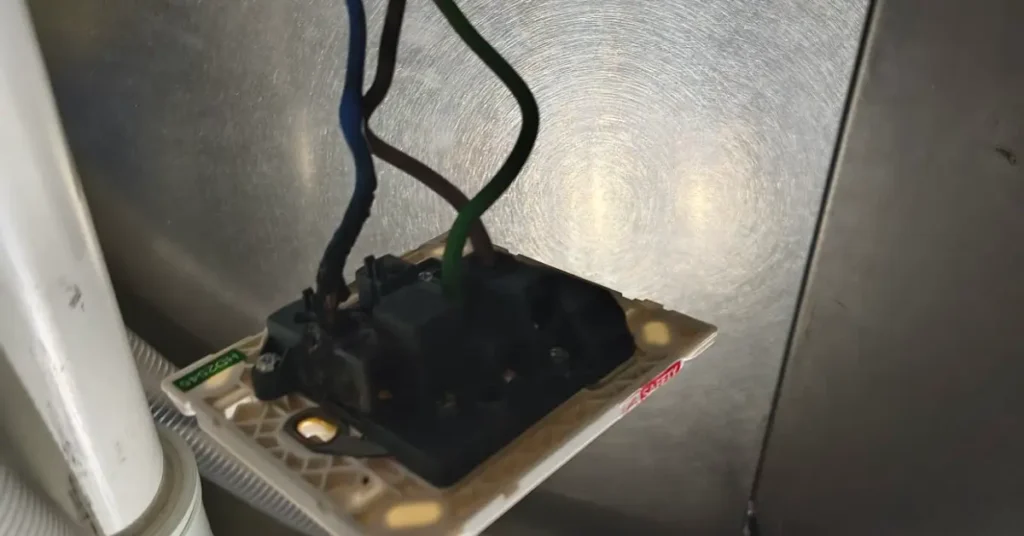
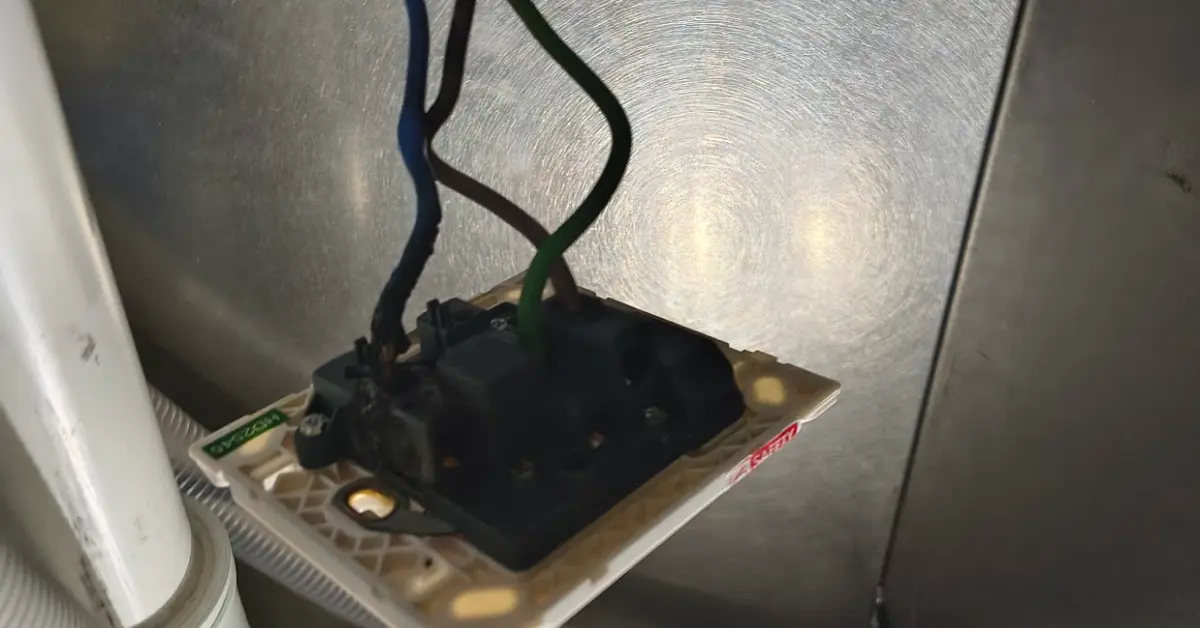
This is the cause we find most often on site. The cable cores are clamped by small screws inside the socket. Daily heating and cooling, vibration, or a job that wasn’t tightened properly lets a screw slacken over the years. A loose joint has higher resistance, so it heats up and arcs, often at completely normal load. The result is a burnt socket: a brown ring around one pin hole and a burning smell from socket terminals before anything trips.
2. Worn-out socket contacts (old sockets)
The spring contacts inside a 13A socket weaken with age and heavy use. A plug that sits loosely makes poor contact, and poor contact means heat and sparks. This is common in older HDB and resale flats where the sockets have never been changed. A worn or sparking socket like this should be replaced, and it’s usually a quick job.
3. Overloading through adaptors and power strips
A standard 13A socket can supply roughly 3,000 W (13 A × 230 V) in total, no matter how many outlets you add with an adaptor. An air fryer (≈1,500 W), a kettle (≈2,200 W) and a microwave on one twin socket through a multi-way adaptor will overheat the socket and can leave you with a burnt socket even if the breaker doesn’t trip straight away. EMA advises against plugging several high-power appliances into one socket. If your kitchen needs more points, see our guide on extension socket installation.
4. Water and moisture
Kitchen backsplash sockets, bathroom-adjacent walls, and ceiling or pipe leaks from the unit above are frequent problems in Singapore’s humid climate. Moisture tracks across the terminals and causes surface arcing, black “tracking” marks and RCCB trips. Fix the leak first, then replace any socket that got wet. A sparking socket near water is an urgent job. If water is seeping from a pipe or the ceiling, our pipe leak repair team can trace the source.
5. Wrong or non-compliant plugs
Singapore uses the 13A Type G (3-pin, fused) plug for most appliances. The Consumer Product Safety Office warns that Schuko (European round-pin) plugs are not suitable: their pins stress the socket contacts and cause poor contact and overheating. Forcing a 2-pin plug into a 3-pin socket without a proper fused adaptor causes the same problem. Imported appliances and cheap travel adaptors are a common source of power socket sparking.
6. Damaged appliance plug or cord
Sometimes the socket is fine and the appliance is the problem: a cracked plug, a bent pin, a loose cord grip or a chafed cable. Test this by checking whether the scorch mark is on the plug pins rather than inside the socket. EMA’s guidance is to stop using appliances with damaged or exposed cables.
7. Ageing or damaged wiring in the circuit
In flats more than 25–30 years old, PVC insulation can harden and crack, especially where cables run through hot ceiling spaces or trunking. Pests can also chew cables, and a renovation nail or screw through a concealed cable is another cause. These faults can leave you with more than one sparking socket on the same circuit, or a circuit that keeps tripping. A replacement socket won’t fix them; the circuit needs testing and possibly rewiring. See our HDB rewiring cost guide if your flat is in this age range.
Why didn’t my RCCB or circuit breaker trip?
Many homeowners don’t expect this, and it’s the main reason a smelly socket shouldn’t be ignored.
- The RCCB only detects earth leakage, meaning current escaping to earth, for example through a person or wet insulation. It doesn’t measure heat.
- The MCB only trips on overcurrent or a short circuit, such as 20 A on a 20 A circuit.
- A loose, arcing terminal can glow hot while drawing perfectly normal current with no leakage to earth. Neither device sees it.
So “the power never tripped” after a power socket sparking incident doesn’t mean the socket is safe. Still test your RCCB monthly with its T button, as EMA recommends. If it keeps tripping, read our RCCB tripping guide.
What if the light switch sparks?
A faint flash you can only see in the dark when you flick a switch is normal arcing inside the switch mechanism. Take action if the switch:
- crackles, buzzes or makes the light flicker,
- feels warm, or has a discoloured rocker or plate,
- sparks visibly around the edge of the faceplate, or
- controls high-load equipment such as a water heater, where a worn 20A DP switch is a frequent failure point.
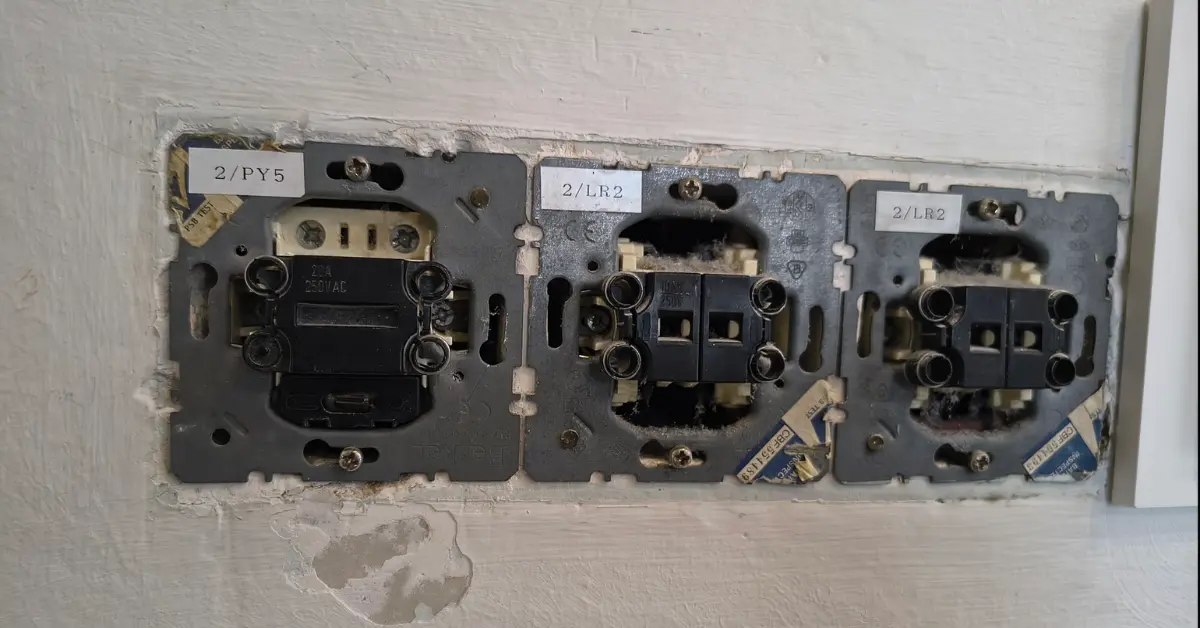
Switches fail for the same reasons as a sparking socket: loose terminals, worn contacts and moisture. They need the same fix, which is isolation and replacement by a licensed electrician.
How much does it cost to fix a sparking socket in Singapore? (2026)
These are typical prices to fix a sparking socket or burnt socket in HDB and condo homes, before GST. The final price depends on access, whether the wiring is surface or concealed, and what we find once the faceplate is off. You’ll get a fixed quote before any work starts.
| Job | Typical price (SGD) | What’s included |
|---|---|---|
| Fault diagnosis / callout | $60 – $120 | Isolation, inspection, insulation and continuity tests. Often waived if you go ahead with the repair. |
| Replace a burnt 13A switched socket (same position) | $80 – $150 | New SAFETY Mark socket, re-terminating the cable ends, functional test |
| Replace a sparking light or water heater switch | $70 – $150 | New switch or 20A DP switch, re-termination, test |
| Cut back and re-terminate a heat-damaged cable | $120 – $250 | Removing damaged conductor ends, new terminations, insulation resistance test |
| Rewire one damaged power-point circuit | $250 – $600 | New cable run from the DB box, surface trunking or concealed (concealed costs more) |
| Add a dedicated point for a high-load appliance | from $250 | New circuit and MCB so you stop overloading one socket |
| RCCB replacement (if it fails the test) | $150 – $320 | New RCCB, trip test |
For full price lists, see electrician prices in Singapore and our power point installation service.
Who is allowed to fix a sparking socket in Singapore?
Under Singapore’s Electricity Act, electrical installation work must be carried out by, or under the supervision of, an EMA-licensed electrical worker (LEW). EMA says an LEW is needed for any work that draws a new connection from the circuit, such as shifting or extending a power point, or rewiring. Simply plugging an appliance into an existing point doesn’t need one. Before you let anyone open your socket, check that:
- the electrician’s licence is valid on EMA’s ELISE portal, or they can show you the licence card,
- replacement sockets and plugs carry the SAFETY Mark (13A plugs, multi-way adaptors and socket-outlets are controlled goods in Singapore), and
- they test the circuit after the repair instead of just swapping the faceplate.
Why not DIY a burnt socket? A YouTube socket swap misses the real cause, such as a heat-damaged cable end or an overloaded circuit, and EMA specifically warns against buying components online for DIY replacement.
How to prevent sockets from sparking
- Switch off before you plug in or unplug high-power appliances.
- One high-load appliance per socket. Never daisy-chain adaptors or power strips.
- Only buy SAFETY Mark adaptors, plugs and extension reels, and avoid Schuko or flat-pin imports.
- Don’t plug a water heater into a 3-pin socket. EMA says it needs a dedicated connection point (see water heater installation).
- Feel the faceplates of your kitchen and aircon-area sockets every few months. Warm means book a check.
- Test your RCCB monthly, and upgrade an old DB box. See our DB box upgrade service.
- Get older flats inspected (25+ years, or a resale flat you’ve just bought) before renovating.
Socket sparking or smelling burnt? Get it checked properly
MM Engineering Works is an EMA-licensed electrical contractor serving HDB, condo, landed and commercial premises across Singapore. Whether it is a sparking socket, a burnt socket or a burning smell from socket outlets, we isolate the fault, find the cause and give you a fixed quote before we start.
Call / WhatsApp: +65 8145 3954 · Email: contact@mmengine.com · Request an assessment
Tip: WhatsApp us a photo of the socket and plug for a faster quote.
Frequently asked questions
Is it normal for a socket to spark when I plug something in?
A single small, quick blue spark when plugging in a high-power appliance with the socket switched on is normal. A large, loud, orange or repeated spark, or any spark with the socket switched off, is not normal. Stop using that socket and have it checked.
Can a sparking socket cause a fire?
Yes. Arcing at a loose or worn connection produces enough heat to melt PVC and ignite nearby materials. SCDF recorded 304 fires of electrical origin in Singapore residential premises in 2025.
Why is there a burning smell from socket outlets?
An overheating socket or cable gives off a burning-plastic or “fishy” smell as the PVC and socket body break down. It means heat damage is already happening. Switch off the circuit at the DB box and call a licensed electrician.
Is a sparking socket safe to use after one spark?
If it was one small spark on plug-in and the socket isn’t warm, discoloured or smelly, it’s usually fine. If there was a large spark, a mark, a smell or a loose plug, don’t use it until an LEW has inspected it.
Why did my socket spark but the power didn’t trip?
RCCBs detect earth leakage and MCBs detect overcurrent. A loose, arcing connection can overheat at normal current without leaking to earth, so neither device trips.
How much does it cost to replace a burnt socket in Singapore?
Replacing a burnt socket (13A, same position) typically costs S$80–S$150 before GST. If the cable ends or the circuit are heat-damaged, repairs range from about S$120 to S$600.
Can I replace a sparking socket myself?
No. Electrical installation work in Singapore must be done by, or under the supervision of, an EMA-licensed electrical worker. A DIY swap also tends to miss the underlying cause, such as a damaged cable end or an overloaded circuit.
What should I do if a sparking socket starts smoking?
Switch off the power at the DB box if you can do it safely, don’t use water, use a CO2 or dry-powder extinguisher only on a small fire, and call 995 if there are flames or the smoke doesn’t stop.
About the author
Malek Bin Sohrab is the owner and project coordinator of MM Engineering Works Pte Ltd (UEN 202302469E), an EMA-licensed electrical contractor at 5 Lorong 4 Geylang, Singapore. He has more than 10 years of experience in residential, commercial and port electrical work, including projects for ICA at Jurong Port. He oversees every sparking socket, power trip and rewiring job the team takes on. More about MM Engineering.
Sources: SCDF Annual Statistics 2025 · EMA: Five common electrical safety questions · EMA: An electrical safety inspector’s view · CPSO: Types of mains plugs suitable for Singapore · CPSO: List of controlled goods
This guide gives general safety information. It doesn’t replace an on-site inspection by a licensed electrical worker. Prices are indicative and exclude GST.